
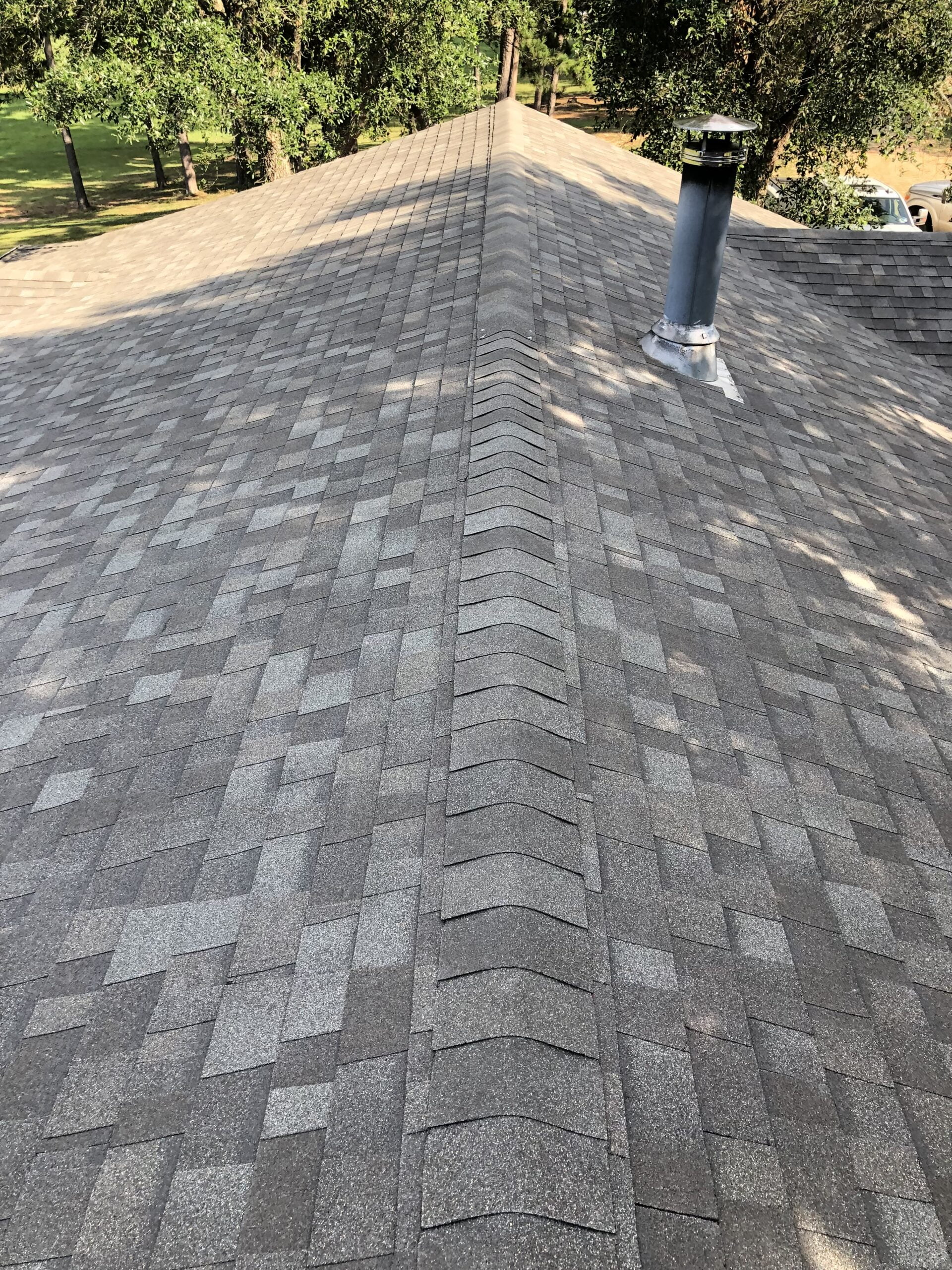
You clean the gutters and find what looks like coarse black sand at the bottom of the downspout. Those are the ceramic granules off your shingles, and finding some is normal. Finding a lot, or finding them suddenly, is information worth acting on.
Here is how to read what you are seeing.
What Granules Do
An asphalt shingle is a fiberglass mat saturated with asphalt. Asphalt degrades under ultraviolet light — it hardens, becomes brittle, and eventually cracks. The layer of ceramic granules embedded in the surface is what stands between the sun and the asphalt.
They do secondary work too: adding fire resistance, providing the shingle’s color, and adding weight that helps the shingle lie flat in wind. But the primary job is UV protection, and that is why losing them matters. A shingle with bare asphalt showing is aging at an accelerated rate from that moment on.
When Granule Loss Is Normal
A New Roof
Expect loose granules for the first weeks after installation. Manufacturing leaves excess granules on the surface that were never bonded, and rain washes them off. This is normal, it tapers off quickly, and it is not a defect. If a brand new roof is still shedding heavily months later, that is worth a call.
Gradual Shedding Over Years
Every asphalt roof sheds slowly across its life. A modest accumulation found during annual gutter cleaning, with no bare spots visible on the roof, is a roof aging normally.
After a Hard Rain on an Older Roof
Heavy rain moves granules that had already worked loose. A slight increase after a downpour on a roof in its second decade is ordinary.
When It Is a Problem
- A sudden heavy accumulation with no storm to explain it — enough to noticeably block a downspout.
- Bare black or gray patches visible on the shingles themselves, where the asphalt mat shows through.
- Granule loss concentrated in one area rather than spread across the roof.
- A sharp increase immediately after a hailstorm, which usually means impact rather than wear.
- Granule loss paired with curling edges, cupping, or cracking — multiple symptoms together indicate a roof near the end of its life.
- Shingles that look noticeably lighter or patchy in color from the ground, which is granule loss at a scale you can see from the driveway.
Telling Wear From Hail
The pattern separates them. Age-related loss is broadly even and heaviest where water concentrates — below valleys, along the drip edge, under roof-to-wall transitions. Hail damage is random in placement and circular in shape, with a soft bruise you can feel in the mat underneath.
A useful cross-check: look at the soft metal around the roof. Dented gutters, downspouts, vents, and turbine caps mean the roof took impacts. If the metal is clean and the granule loss is even, you are looking at wear. Our post on what hail damage actually looks like covers the distinction in detail.
Why East Texas Is Hard on Granules
Two local factors accelerate this. The first is heat. Sustained high temperatures soften asphalt, and a softened shingle holds its granules less firmly — which is part of why walking a roof on a hot afternoon damages it and why reputable crews avoid it where they can.
The second is thermal cycling. Roof surface temperatures swing enormously between a scorching afternoon and a cool night, and every cycle expands and contracts the shingle slightly. Repeated thousands of times, that works granules loose from the asphalt binding them.
Poor attic ventilation makes both worse by heating shingles from underneath as well as above. That is one of the more overlooked contributors to premature roof aging in this region, and we covered it in why East Texas attics cook.
What to Do About It
If you are finding a modest amount and the roof looks uniform from the ground, note it and keep an eye on it. Check again at the next gutter cleaning and compare.
If you are finding a lot, seeing bare patches, or the roof is past fifteen years, get it inspected. The useful question is not whether granule loss exists — it always does — but how much of the roof’s service life is left and whether you are heading toward a planned replacement or an emergency one.
One thing that does not work: sweeping or blowing the roof to “clean” it. Pressure washing is worse and will strip granules aggressively. A roof does not need to be cleaned of granules; it needs to be assessed for why it is losing them.
Keep the Gutters Themselves Clear
Separate but related — accumulated granules and debris in a gutter hold water against the fascia and the roof edge, which causes rot behind the drip edge. Clearing gutters is worth doing regardless of what the granule volume tells you about the shingles.
Get an Honest Read on Your Roof
Granule loss is one of the more reliable indicators of where a roof is in its life, but only when someone reads it alongside the shingle condition, the flashing, and the ventilation. In isolation, a handful of granules means very little.
East Texas Roofing LLC provides free roof inspections across Crockett, Palestine, Tyler, Lufkin, and the rest of East Texas, with an honest answer about how much life your roof has left. Contact East Texas Roofing or call (936) 222-0824.